Is Your ERP Hindering Your Business? Here’s 8 ways To Tell

Image by Oracle NetSuite
Is Your ERP Hindering Your Business? Here’s 8 ways To Tell
🔗: Transitioning can be daunting. Let’s discuss.
Reasons Your ERP Might Need an Update:
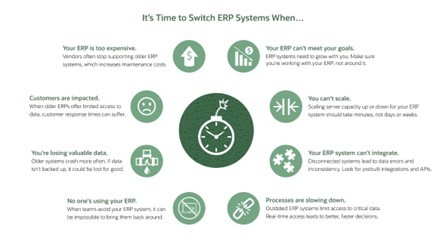
1. Not Syncing with Business Goals: As startups flourish, tools like QuickBooks might fall short. Business expansion, particularly internationally or across intricate product lines, needs an ERP that’s robust and adaptable to these changes.
2. Scalability Roadblocks: A modern ERP should effortlessly handle fluctuating demands. If upgrading or adjusting your system is draining time and finances, it’s not scaling efficiently with your growth.
3. Integration Hurdles: A growing company often juggles multiple software. When these don’t communicate, it can birth inconsistencies—like selling out-of-stock products—which jeopardize operations and customer trust.
4. Operational Lags: If accessing data is a marathon, or if you’re noticing mounting manual workarounds, your ERP is not enhancing your processes but hampering them.
5. Declining Usage: Employees bypassing the ERP is troubling. This could stem from a feeling of exclusion during ERP decisions, inadequate training, or the system simply not being intuitive.
6. Data Concerns: Legacy ERPs, over time, can crash, lose data, or become security risks. If your system is increasingly vulnerable, you’re risking not just data, but your business’s reputation.
7. Customer Setbacks: If slow processes, like order fulfillments or customer service delays, trace back to your ERP, it’s not just a company issue—it’s jeopardizing your customer relationships.
8. Cost Surges: A consistently escalating maintenance cost, coupled with a need for constant patches or consultations, is a sign that your ERP isn’t economically viable anymore
Why Oracle NetSuite is the ERP Game-Changer
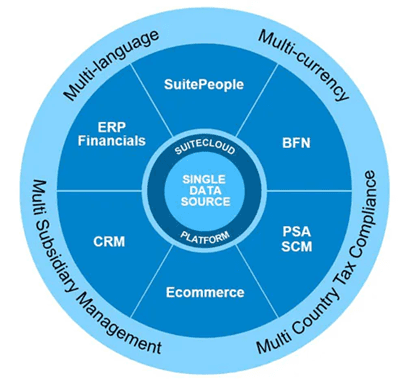
Centralized and Integrated Solution: NetSuite ERP stands out with its cloud-based architecture, offering an all-in-one suite of applications housed in a unified database. This design ensures seamless business processes, fosters enhanced collaboration and delivers pinpoint, real-time insights into operational trends. Its modular approach also gives businesses the flexibility to incorporate additional functionalities, catering to both front-end and back-end operations, without the hassles of traditional system extensions.
Simplified Transition with Expert Support: For businesses contemplating the switch from legacy systems, NetSuite offers a holistic transition toolkit. This includes intuitive application programming interfaces (APIs) for customizations and integration, and the SuiteSuccess framework—a treasure trove of best practices drawn from numerous successful implementations, fast-tracking the value realization. Moreover, with NetSuite’s Customer Success division, companies can access a pool of certified consultants, ensuring a tailored implementation plan addressing specific needs and challenges.
About the author

Dominic Gopal is the CEO of Hypernix Sdn Bhd, a leading digital transformation consultancy in Malaysia. With over 34 years of experience in ERP, RPA, and AI-driven solutions, he has led 50+ successful implementations, helping enterprises achieve smarter, scalable operations.