What Is ERP Data Fragmentation and Why It's Quietly Costing Malaysian Businesses
A recent article by James Alan Miller titled “Learn how ERP data fragmentation undermines stability” highlights a challenge many organizations overlook until it begins affecting decision-making and governance.
In almost every ERP engagement we start, we find the same hidden problem and it is rarely what the client expected. The system is running. Reports are generating. The financial close happens on schedule. But underneath, the business has quietly fractured into three or four competing versions of the same data.
This is ERP data fragmentation. Unfortunately it is one of the most underdiagnosed risks in Malaysian businesses today.
Key Takeaways
ERP data fragmentation creates multiple versions of the truth
Different departments operate with inconsistent data, reducing confidence in reporting and decision-making.
The issue develops quietly but impacts long-term stability
Systems continue running, but underlying inconsistencies weaken governance and business alignment over time.
Fragmented data increases risks during ERP upgrades or cloud migration
Without resolving data issues first, modernisation efforts carry forward the same inconsistencies.
A unified data model is critical for ERP success
Centralising data, defining ownership, and structuring integrations help eliminate silos and maintain consistency.
Data confidence enables better business performance
When leadership can trust the numbers, organisations can make faster decisions and build a stronger foundation for analytics and growth.
The Hidden Problem: When ERP Data Tells Different Stories
Data fragmentation usually develops quietly.
Typical symptoms include:
Customer records that exist in slightly different forms across departments
Supplier hierarchies that vary between procurement and finance
Revenue calculations that differ between regional and consolidated reports
These inconsistencies rarely break the ERP system immediately. Instead, they create multiple versions of operational truth, gradually weakening reporting accuracy and governance.
Imagine a company where:
Finance reports RM50M revenue
Sales reports RM52M
Operations reports RM48M
All numbers are “close enough,” but leadership loses confidence in the data.
This is the real cost of fragmented ERP data.
Why ERP Modernization Often Fails
Many organizations attempt digital transformation without resolving data fragmentation first.
During ERP upgrades or cloud migration:
Integration logic becomes inconsistent
Master data ownership becomes unclear
Reporting definitions diverge across business units
The result is a modern system running on old, inconsistent data foundations.
The technology changes — but the problem remains.
How to Fix ERP Data Fragmentation with Oracle NetSuite
At Hypernix, we see ERP not just as software implementation but as a foundation for a unified business data model.
Using Oracle NetSuite, we help clients address fragmentation through several practical steps.
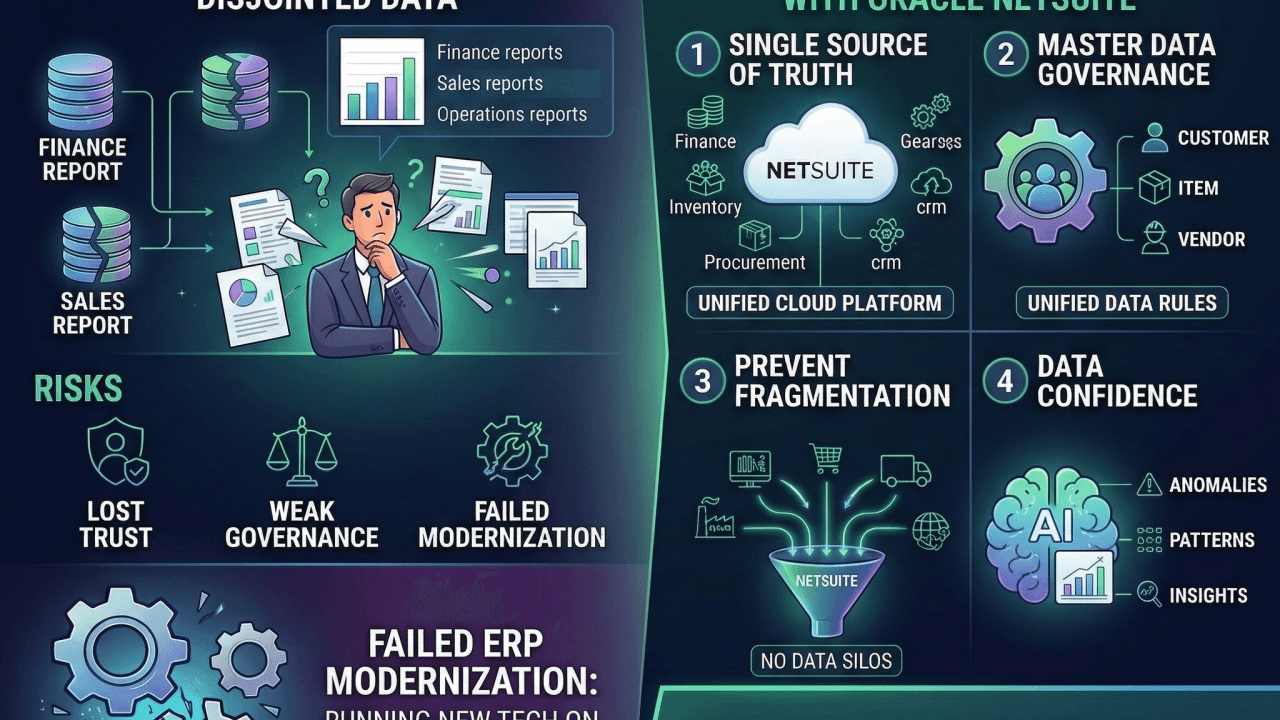
1. Establish a Single Source of Truth
NetSuite centralizes financial, operational, and transactional data into one cloud platform.
Instead of scattered systems for finance, inventory, procurement, and CRM, businesses operate from a single consistent dataset.
Example: A retailer running POS, finance, and inventory on separate systems often struggles with reconciliation. By consolidating into NetSuite, all transactions update one central ledger.
2. Master Data Governance
One of the biggest fragmentation causes is unclear ownership of master data.
Hypernix helps clients define governance such as:
Who owns customer master data
Who maintains item and inventory classifications
How vendor hierarchies are structured
This ensures consistent definitions across the business.
3. Integration Architecture That Prevents Fragmentation
Modern businesses operate many systems:
POS
Manufacturing systems
eCommerce platforms
IoT devices
Vendor portals
Hypernix designs integrations that ensure these systems feed clean, structured data into NetSuite rather than creating isolated data silos.
4. AI-Driven Analytics for Data Confidence
Once data is unified, organizations can unlock deeper insight.
With tools such as NetSuite Analytics Warehouse, businesses can:
Detect anomalies in transactions
Identify inconsistent data patterns
Generate predictive insights
This moves companies from reactive reporting to proactive decision-making.
The Real Goal: Data Confidence with ERP System
The ultimate objective is simple.
Leadership must trust the numbers.
When data fragmentation disappears, businesses gain:
Reliable reporting
Faster decision-making
More predictable ERP upgrades
A stronger foundation for AI and analytics
ERP stability is not just about technology. It’s about data consistency across the enterprise.
Final Thought
The article by James Alan Miller raises an important reminder: ERP systems rarely fail dramatically — they slowly lose coherence when data fragments across the organization.
The companies that succeed in digital transformation are those that fix the data foundation first.
At Hypernix, that is exactly where we start. We work with mid-market businesses across Malaysia and Southeast Asia to diagnose and resolve ERP data fragmentation — from initial assessment through to full Oracle NetSuite implementation and governance design.
The companies that succeed in digital transformation are those that fix the data foundation first. That is exactly where we start. Contact us now to learn more.
FAQs about ERP Data Fragmentation
What is ERP data fragmentation?
ERP data fragmentation occurs when different departments or systems hold conflicting versions of the same business data such as customer records, revenue figures, or inventory counts with no single authoritative source.
What are the signs of ERP data fragmentation in a business?
Common signs include finance, sales, and operations reporting different revenue figures; manual reconciliation required at month-end; no clear ownership of master data; and integration projects that repeatedly produce data quality issues.
Why does ERP data fragmentation cause ERP modernization to fail?
When businesses migrate or upgrade ERP systems without resolving fragmentation first, inconsistent data moves into the new system. It means the technology changes but the underlying problem remains.
How does Oracle NetSuite solve ERP data fragmentation?
Oracle NetSuite centralises financial, operational, and transactional data on one cloud platform, eliminating the silos that cause fragmentation. Combined with master data governance and structured integrations, it creates a single source of truth across the business.
How long does it take to fix ERP data fragmentation?
Timeline depends on the number of systems, data volume, and governance complexity. Hypernix typically addresses foundational fragmentation issues as part of the ERP implementation scoping phase before go-live.
About the author

Dominic Gopal is the Founder and CEO of Hypernix Sdn. Bhd., a leading Oracle NetSuite and Aptean ERP partner in Malaysia, and a two-time Oracle NetSuite Partner Award winner. Hypernix specialises in digital transformation for mid-market companies across manufacturing, Oil & Gas, F&B, and retail.