Your ERP Is Working. Your Finance Director Is Still on Spreadsheets. Here's Why.
We've been here before.
A company spends months — sometimes years — implementing an ERP. The go-live is celebrated. The data is finally in one system. Everyone breathes a sigh of relief.
Then you walk past the Finance Director's desk.
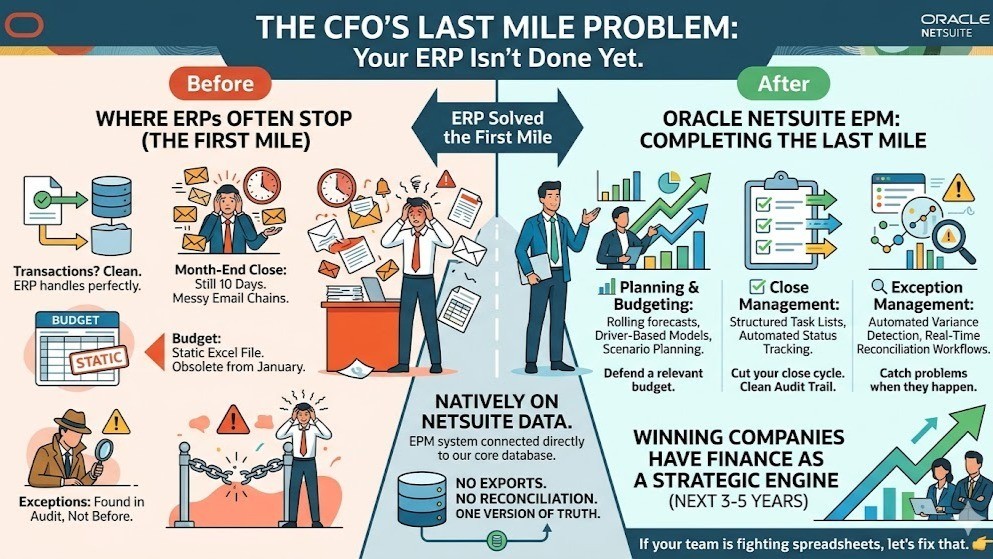
Three Excel files. A pivot table that took two hours to build. A budget model that hasn't been touched since Q1 because nobody has time to maintain it. And a month-end close that still takes ten working days despite the "digital transformation."
This is what industry observers are calling the CFO's Last Mile Problem — and it's more widespread than most vendors will admit.
Key Takeaways
ERP systems often stop at transactions, not decision-making. Planning, forecasting, and reporting are still handled outside the system.
The CFO’s last mile problem keeps finance teams on spreadsheets. Critical processes like budgeting and month-end close remain manual.
Disconnected systems slow down performance and increase risk. Data silos lead to inefficiencies, delays, and limited visibility.
An integrated EPM layer closes the gap. Solutions like Oracle NetSuite EPM unify planning, close management, and reporting.
Modern finance teams become strategic drivers of growth. With real-time insights, businesses can make faster and more confident decisions.
The ERP Software Gap Nobody Talks About
ERP systems do a tremendous job at the transactional layer. Invoices, purchase orders, inventory movements, payroll — the system of record is solid. But the moment a CFO or Finance Director needs to plan, analyse, close, or act on that data, they're often back to manual workarounds.
The result?
Month-end close cycles extend as finance teams work through manual processes to align data across systems
Highly skilled finance professionals spend a growing portion of their time on operational tasks rather than analysis, forecasting, and strategic support
Budgets are static documents, not living plans
Anomalies are discovered in reports — not prevented in real time
Board packs are assembled, not generated
Finance teams end up drowning in spreadsheets, chasing numbers across siloed systems, and still struggling to answer the most basic question: "Do we have the cash to do this?"
The irony is painful: the ERP was supposed to fix this.
The Real Problem: Your ERP System Stops at the Transaction
Most ERP implementations focus on getting the data in. Far fewer focus on what happens after — the planning, the close, the exception management, the financial storytelling that CFOs are now expected to deliver in real time.
Today's CFOs are no longer just stewards of the books. They are expected to forecast, scenario-plan, manage risk, and advise the board — all at speed, and all with a single version of the truth. That's a seismic shift. But most mid-market companies are still running their planning cycle on a disconnected spreadsheet and their close process on email chains.
How Oracle NetSuite EPM Solves the CFO's Last Mile Problem
Oracle NetSuite isn't just an ERP. For finance leaders who want to close the last mile, it comes with a purpose-built Enterprise Performance Management (EPM) layer that sits natively on top of the same data — no exports, no reconciliation, no "version of the truth" debates.
Here's how it directly addresses the gaps:
1. NetSuite Planning and Budgeting — From Static Budgets to Living Plans
Most companies budget once a year, then spend the rest of the year defending numbers that no longer reflect reality. NetSuite Planning and Budgeting replaces that broken cycle with driver-based, rolling forecasts that connect directly to your NetSuite actuals.
Department heads can submit their own inputs. Finance consolidates automatically. Scenario modelling — best case, worst case, base case — is built in. In a world of rising volatility and compressing planning cycles, that infrastructure isn't a luxury. It's a necessity.
2. NetSuite Close Management — Cut Your Month-End in Half
Month-end close is still one of the most painful processes in finance. Tasks are tracked in email. Preparers and reviewers work in silos. Nothing is auditable until it's too late.
NetSuite Close Management brings a structured task list, role assignments, automated status tracking, and audit trails — all inside the same platform where the journal entries live. The result: faster close cycles, cleaner audits, and Finance Directors who actually get to leave the office before the 10th of the month.
3. NetSuite Financial Reporting & Exception Management — Stop Finding Problems, Start Preventing Them
The biggest risk in any finance function isn't fraud. It's undetected errors that compound quietly until they surface in an audit or a board meeting.
NetSuite's exception management and financial reporting capabilities give finance teams automated variance detection, reconciliation workflows, and real-time exception flagging — all mapped back to the GL the moment a transaction posts. Exceptions are caught when they happen — not when someone eventually gets around to checking the spreadsheet.
The Bigger Picture: One Oracle ERP Platform, Zero Gaps
The CFO's Last Mile Problem isn't a people problem. It's an architecture problem.
When your planning tool, your close tool, your reconciliation tool, and your ERP are all different systems — or worse, all different spreadsheets — the last mile becomes a marathon.
Oracle NetSuite, when properly implemented with its EPM suite, closes that gap entirely. One data model. One platform. One version of the truth — from journal entry to board pack.
What This Means for Growing Companies in Malaysia
If you're a mid-market business in manufacturing, distribution, Oil & Gas, retail, or F&B— this isn't a theoretical problem. Every day your Finance team spends fighting spreadsheets is a day they're not analysing margin, forecasting cash, or flagging risk.
The companies that will win in the next three to five years are the ones where Finance is a strategic engine — not a reporting bottleneck.
The technology to make that shift is available today. The question is whether your ERP implementation is truly done — or whether you've only solved the first mile.
At Hypernix, we help mid-market organisations across Malaysia and Southeast Asia close the last mile — from NetSuite implementation to EPM deployment. If your Finance Director is still on spreadsheets, let's talk.
FAQs About Oracle NetSuite and ERP Financial Management in Malaysia
What is the CFO's Last Mile Problem in ERP?
The CFO's Last Mile Problem refers to the gap between what ERP software handles well, transactions such as invoices, purchase orders, and payroll and what finance leaders actually need: planning, budgeting, close management, and real-time financial reporting. Most ERP system implementations solve the transactional layer but leave the last mile to spreadsheets.
What is Oracle NetSuite EPM?
Oracle NetSuite EPM (Enterprise Performance Management) is a suite of financial management tools built natively on top of Oracle NetSuite . It includes Planning and Budgeting, Close Management, Account Reconciliation, and Financial Reporting. All are connected to the same data model as the core ERP, eliminating the need for data exports or manual reconciliation.
How does NetSuite Planning and Budgeting work?
NetSuite Planning and Budgeting replaces static annual budgets with driver-based, rolling forecasts that connect directly to NetSuite actuals. Department heads submit their own inputs, finance consolidates automatically, and scenario modelling is built in, giving CFOs a living plan that reflects current business reality.
How long does a NetSuite EPM implementation take in Malaysia?
Timeline varies depending on the complexity of your finance processes and whether NetSuite ERP is already in place. For businesses already on NetSuite, EPM modules can typically be activated and configured within weeks. Hypernix manages the full Oracle ERP software implementation process from scoping to go-live across Malaysia and Southeast Asia.
Can Hypernix help us close the gap between our ERP and our Finance team's needs?
Yes. Hypernix specialises in Oracle NetSuite implementation and EPM deployment for mid-market companies across Malaysia and Southeast Asia. We start by understanding where your Finance team is still working around the ERP, and build a solution that closes those gaps entirely. Talk to our team to get started.
About the author

Dominic Gopal is the Founder and CEO of Hypernix Sdn. Bhd., a leading Oracle NetSuite and Aptean ERP partner in Malaysia, and a two-time Oracle NetSuite Partner Award winner. Hypernix specialises in digital transformation for mid-market companies across manufacturing, Oil & Gas, F&B, and retail.