How a Hypernix CEO Built a Custom AI CRM in One Sunday
How a CEO with no development background built a fully functional CRM for RM 130 per month — and what it signals for every business running Oracle NetSuite or any ERP system in Malaysia.
Key takeaways
AI has removed the traditional barriers to building custom software
Business leaders can now create working systems in days instead of months, without large teams or budgets.Custom solutions can outperform generic SaaS in both fit and cost
Systems built around your workflows deliver better usability and can run at a fraction of subscription costs.Ownership of software is becoming a strategic advantage
Custom-built systems become proprietary assets, not recurring expenses, strengthening long-term business value.Speed of execution is now a competitive differentiator
Companies that act quickly can build internal tools, capture efficiencies, and stay ahead while others are still evaluating AI.The real leverage comes from clear thinking, not just AI tools
Solving a specific business problem with clarity leads to practical, usable outcomes from day one.
“I Built a Custom CRM in One Sunday Using AI. By Next Week, My Sales Team Will Be Using It Instead of Paying RM 2,000 a Month for Someone Else's”
Last Sunday, I woke up, made coffee, and sat down with an AI.
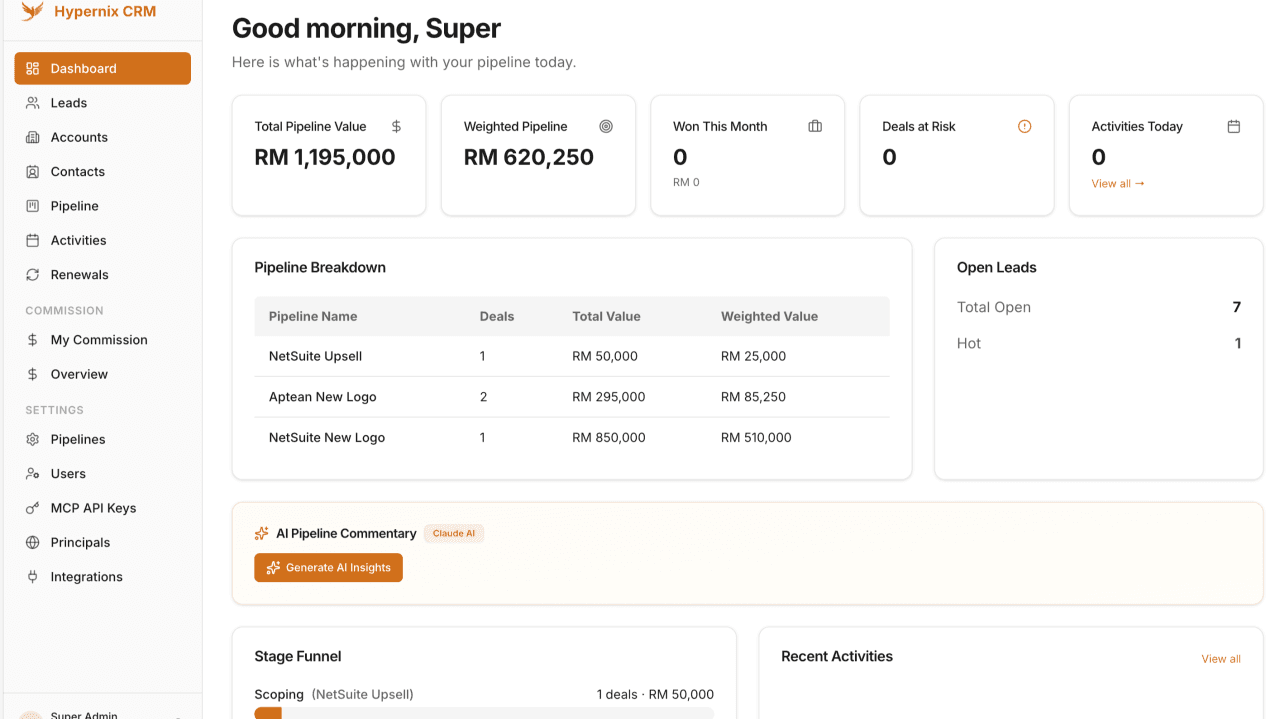
By the time I went to bed that evening, I had a working Version 1.0 of the Hypernix CRM — a custom-built, fully functional Customer Relationship Management system with a live database, a working API, role-based user access, a Pipeline Kanban board, lead scoring, account management, and an AI intelligence layer running inside it.
One Sunday.
Not a prototype on paper. Not a mockup in Figma. A real, deployed application that my sales team will be using this week — instead of paying significantly more for a generic SaaS tool that was never designed for how we actually work.
I am writing this because I think most business leaders are having completely the wrong conversation about AI. And what happened last Sunday is proof of why.
The Honest Starting Point: Why an ERP Software Company in Malaysia Needed to Change
Hypernix is a leading Oracle NetSuite and Aptean ERP partner in Malaysia. We help mid-market companies transform their operations with world-class business systems.
The irony that I have sat with for a while: we sell digital transformation to our clients while our own internal sales operations ran on a combination of generic CRM subscriptions, Excel pipelines, and WhatsApp threads.
The result:
Pipeline visibility gaps
Manual commission calculations in spreadsheets
Missed renewal reminders
Manual updates for our Oracle partner manager
We were paying a premium every month for software that did not fit us — because building something custom had always seemed like a project that required a development team, a six-figure budget, and months of time.
Last Sunday changed that assumption permanently.
One Sunday. Here Is What Actually Happened.
I used two tools.
Claude by Anthropic — my AI thinking partner. I described what I needed in plain business language. Claude designed the data model, the API structure, the user interface, and the security rules. It generated the precise build instructions for every module. When something broke, I described the symptoms and Claude diagnosed the fix.
Replit — a browser-based platform where an AI agent takes those instructions and autonomously writes the code, sets up the database, and deploys the application. You describe the requirement. It builds it.
The workflow:
Claude designs each module in plain business language
I pass the structured design as a prompt to Replit Agent
Replit builds and deploys
Claude validates the output and troubleshoots issues
No developer. No agency. No lengthy tender process.
By end of Sunday I had Version 1.0 of the Hypernix CRM live with:
Dynamic sales pipelines — separate for NetSuite New Logo, NetSuite Upsell, and Aptean, each fully configurable
Lead management with automatic scoring from 0 to 100 based on industry fit, budget, product interest, and timeline
Full account and contact management with AR balance tracking
A Pipeline Kanban board with deal cards, stage probabilities, and weighted values
A CEO dashboard with real-time pipeline health metrics
Role-based access for seven user types from Super Admin to Read Only
An AI layer powered by Claude API for deal summaries, next best action suggestions, and MOM generation from meeting transcripts
Is it perfect? No. We are tightening things up this week. But is it working, is it ours, and will the sales team be using it instead of a generic subscription by next Friday?
Absolutely yes.
What Makes a Custom AI CRM Different From Just Buying a CRM
Every CRM on the market was built for a generalised version of a sales team. Ours was built for exactly how Hypernix operates.
We have a Principal Portal — a separate secure login where our Oracle and Aptean principals can see our pipeline filtered to their product in a read-only Kanban view. No other partner our size has this. No generic CRM would build it for us. We designed it, we built it, it is live.
We have a Recurring Revenue tracker — every Oracle NetSuite licence renewal, every maintenance contract, every SaaS subscription tracked with automated reminders at 180, 90, 60, 30, 14, and 7 days before expiry, and a follow-through checklist per renewal. When a renewal is marked Won, the next renewal record is auto-created.
We have an Exit Readiness Scorecard — a dashboard that tracks the KPIs an acquirer would evaluate: ARR growth, client retention rate, win rate, pipeline coverage, and licence-to-services revenue mix. Because we are building Hypernix with a 3-year exit strategy in mind, that data needs to be visible and clean from day one.
We have a Commission Module — automatic commission calculation per deal, configurable rates per pipeline, multi-rep splits, approval flow, and full visibility for each sales rep on their projected earnings in real time.
And none of this required negotiating with a vendor, waiting for a feature roadmap, or paying per-seat pricing that scales against us as we grow.
The Cost Difference
Solution | Monthly Cost | Notes |
Hypernix CRM | ~RM 120–130 | As of April 2026, based on internal deployment |
Comparable SaaS CRM | RM 2,000–5,000 | Generic fit with per-seat pricing model |
More importantly: this software belongs to Hypernix. It sits on our balance sheet as proprietary IP. It will appear in any acquisition due diligence as evidence of operational maturity and technology capability. A generic SaaS subscription appears in due diligence as a cost line.
One Sunday built us an asset. Not a subscription.
What the AI Era Means for ERP Systems and Business Automation
I am not a developer. I have not written a React component or an SQL query in years. I am a CEO running a 10-person consultancy focused entirely on client delivery and business growth.
And in one Sunday, I built production software.
The conversation in most boardrooms right now is about AI risk. Will it replace our people? Is it safe? Should we wait and see how it develops?
These are the wrong questions — or at least they are the wrong questions to start with.
The right question is this: what problems in my business would I solve tomorrow if the barrier between having an idea and having a working solution was a single Sunday?
Because that barrier is now a single Sunday.
The leaders who internalise this and act on it will have working systems, proprietary IP, and competitive advantages that compound over time. The ones who are still debating AI readiness in 12 months will be explaining to their boards why their competitors moved faster.
Three Things I Would Tell Any Business Leader Right Now
Start with a real business problem, not an AI experiment.
I did not sit down on Sunday to "explore AI." I sat down to solve a specific problem — we needed a CRM that fit how we work, and we were paying too much for one that did not. The AI was the means, not the end. When you start from a genuine business problem, the output is useful from day one.
The leverage is in the thinking, not the technology.
AI amplifies clarity. The reason Version 1.0 came out working is not because the tools are magical — it is because I spent time thinking carefully about what I actually needed before I asked the AI to build it. Fuzzy requirements produce fuzzy results regardless of how good the tools are.
Do not wait for perfect. Build Version 1.0 and improve from there.
The Hypernix CRM is not finished. It is working, it is live, and it is already better than what we had. Version 2.0 will be better than Version 1.0. This is how good software gets built — not by waiting until everything is perfect before anyone sees it.
The Road Ahead: Agentic AI, Robotic Process Automation, and What Comes Next
This week the sales team onboards. We are entering real client data, real opportunities, and real pipeline values. The AI features go live once the Claude API key is configured. Microsoft 365 integration — Outlook email sync and Teams meeting creation — activates once we complete the Azure registration.
Within 30 days, our Oracle partner manager will have their Principal Portal login and real-time pipeline visibility without a single manual update from our side.
Within 90 days, the same AI-driven approach that built the Hypernix CRM will be informing the agentic automation solutions we design for our clients.
Because if we can do this in one Sunday — what can our clients do in a quarter with the right architecture and the right partner guiding them?
That is the question I am now very excited to answer.
If you want to explore what AI-driven transformation could look like for your business, whether that starts with your ERP implementation, your automation strategy, or a digital advisory session, let us talk. Contact us today to get started.
FAQs About AI Automation and ERP Software in Malaysia
Can AI really build business software without a development team?
Yes, and this article is proof. Using Claude by Anthropic for design and Replit for deployment, the full Version 1.0 Hypernix CRM was built and deployed in a single day at approximately RM 120–130 per month in running costs (as of April 2026, in our deployment). The key is starting with a clearly defined business problem and using AI as a structured thinking partner, not just a code generator.
What is the difference between traditional robotic process automation and agentic AI?
Traditional robotic process automation (RPA) uses rules-based bots to automate repetitive, structured tasks such as data entry, invoice processing, or report generation. Agentic AI goes further: it can reason, make decisions, and execute multi-step workflows autonomously based on context. The two approaches are complementary, and at Hypernix, we help Malaysian businesses evaluate which combination of ERP software, RPA, and agentic AI best fits their operations.
Is Hypernix an RPA and AI automation company in Malaysia?
Hypernix is primarily a leading Oracle NetSuite and ERP implementation partner in Malaysia, with a growing practice in intelligent automation and agentic AI. We help mid-market businesses across manufacturing, Oil & Gas, F&B, and retail build the systems they need.
How much does it cost to build custom AI business software in Malaysia?
The Hypernix CRM, a fully functional system with pipeline management, lead scoring, commission tracking, and an AI intelligence layer runs at approximately RM 120–130 per month in infrastructure costs (as of April 2026, in our deployment). Comparable features from established SaaS CRM platforms in Malaysia would cost RM 2,000 to RM 5,000 per month. The key advantage of custom AI-built software is that it becomes proprietary IP, not a recurring cost line.
How can ERP software companies in Malaysia use AI to improve operations?
ERP software companies in Malaysia can use AI to build custom internal tools, automate reporting workflows, generate real-time pipeline summaries, and surface predictive insights from their existing ERP data.
At Hypernix, we are applying the same AI-driven approach to the solutions we design for clients, combining ERP implementation expertise with emerging agentic AI capabilities to deliver systems that are truly built for how each business works.
About the author
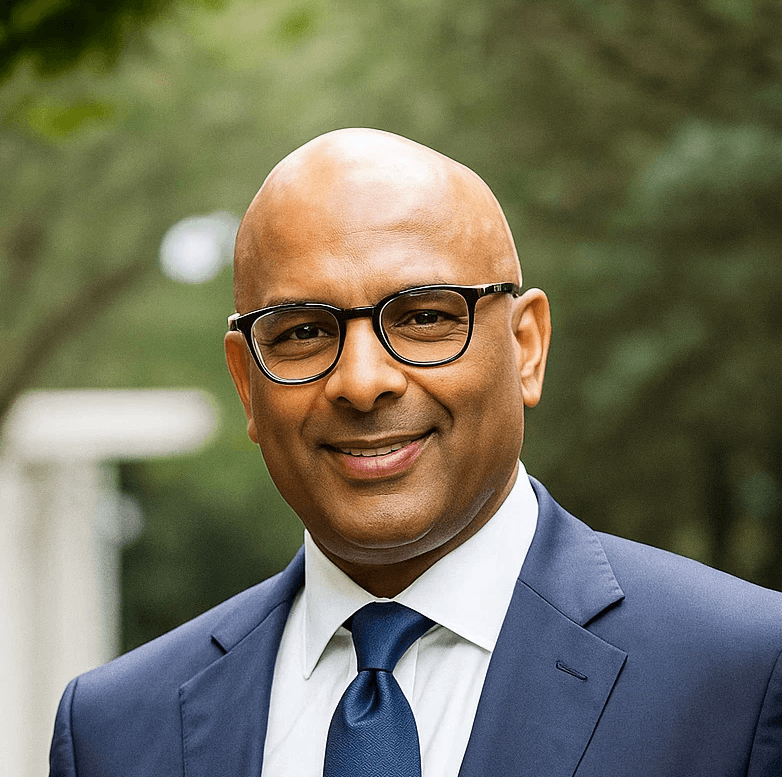
Dominic Gopal is the Founder and CEO of Hypernix Sdn. Bhd., a leading Oracle NetSuite and Aptean ERP partner in Malaysia, and a two-time Oracle NetSuite Partner Award winner. Hypernix specialises in digital transformation for mid-market companies across manufacturing, Oil & Gas, F&B, and retail.