Oracle NetSuite vs Microsoft Dynamics: The Real AI Battle in ERP Is About Freedom, Not Features
Six months ago, everyone was talking about GPT-4o. Three months ago, Claude became the model of choice for developers and enterprises alike. Next quarter? It could be something else entirely.
This is the reality of AI in 2026: the best model today won't necessarily be the best model tomorrow. And this has massive implications for how businesses should think about AI inside their ERP.
I've spent years working with Oracle NetSuite and have watched the AI strategies of both NetSuite and Microsoft Dynamics unfold in real time. Both are heading toward the same destination — intelligent, AI-driven enterprise operations. But the roads they're taking couldn't be more different.
And that difference matters more than most CFOs and CIOs realize.
Key takeaways
The real AI battle in ERP is about flexibility, not features
Choosing an ERP today means deciding how adaptable your AI strategy will be in the future.Microsoft Dynamics offers deep integration but comes with vendor lock-in
Copilot delivers seamless AI capabilities within the Microsoft ecosystem, but ties businesses to a single AI provider.Oracle NetSuite enables a “Bring Your Own AI” approach
Businesses can integrate and switch between AI models such as GPT, Claude, or Gemini without restructuring their ERP system.AI flexibility is critical in a rapidly evolving landscape
With AI models changing quickly, the ability to adapt and adopt new technologies is a long-term competitive advantage.Future-ready ERP strategies prioritise freedom of choice
The best ERP is not the one with the best AI today, but the one that allows access to the best AI tomorrow.
Microsoft Dynamics + Copilot: The All-In-One Bet
Microsoft's strategy is bold and deeply integrated. Copilot is now woven into virtually every Dynamics 365 module — Sales, Finance, Supply Chain, Customer Service. It surfaces insights, drafts emails, automates workflows, and even deploys autonomous agents that work around the clock.
It's impressive. And for organizations already living inside the Microsoft ecosystem — Teams, Outlook, SharePoint, Power Platform — the seamlessness is genuinely compelling. Everything talks to everything else.
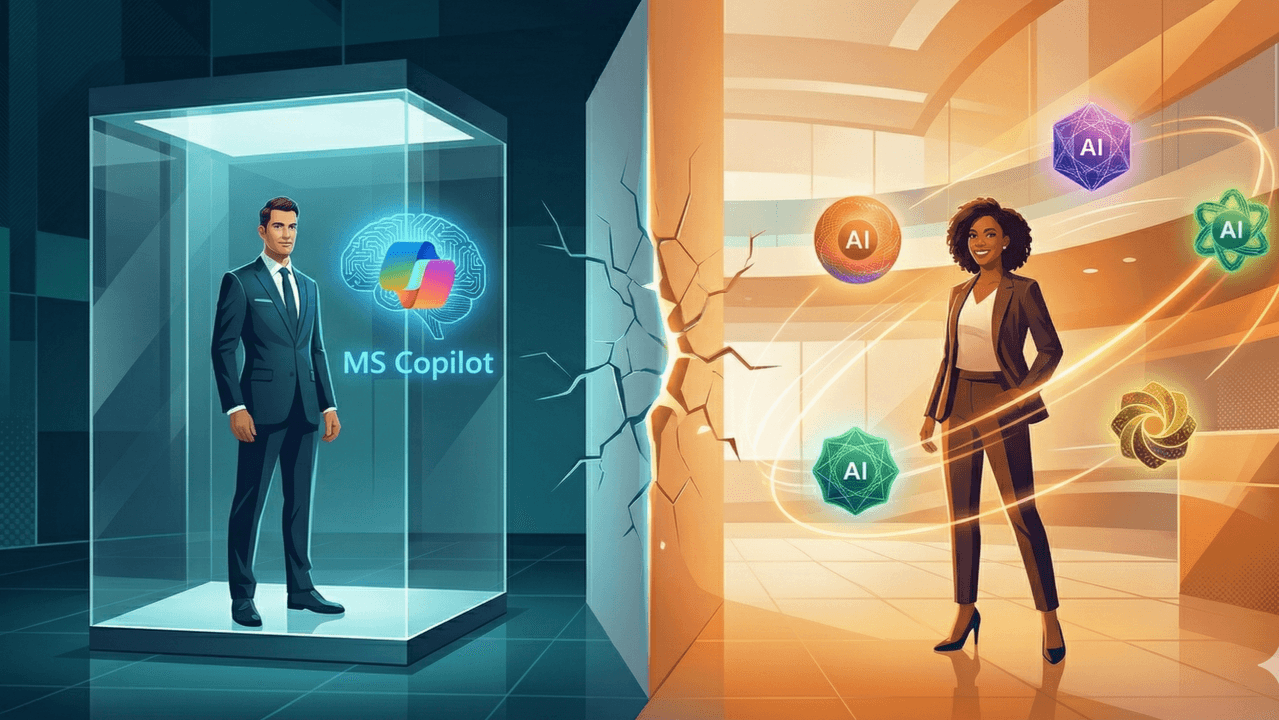
But here's the trade-off most people don't discuss: when you adopt Copilot across Dynamics 365, you're making a bet that Microsoft's AI will remain the best option for your business. You're tying your AI capability to one vendor's model, one vendor's roadmap, and one vendor's pricing decisions.
Today, that bet might feel safe. Microsoft has the resources, the partnerships, and the distribution.
But the AI landscape doesn't reward loyalty. It rewards adaptability.
Oracle NetSuite's Play: Bring Your Own AI into Your ERP System
Oracle NetSuite took a fundamentally different approach with the 2026 R1 release of the NetSuite AI Connector Service.
Instead of locking customers into a single AI provider, NetSuite built an open, governed framework that lets businesses connect the AI model of their choice — whether that's OpenAI's GPT, Anthropic's Claude, Google's Gemini, Meta's Llama, or models served through Amazon Bedrock and Microsoft Foundry.
Read that last part again. NetSuite even supports connecting Microsoft's own AI models through Azure. That's not competition — that's confidence in an open architecture.
The AI Connector Service uses the Model Context Protocol (MCP), meaning it's not just a simple API wrapper. It provides role-based access, governance controls, and data security guardrails that let enterprises bring external AI into their ERP without compromising compliance or data integrity.
This is what "Bring Your Own AI" actually looks like in practice:
Your finance team prefers Claude for its nuanced reasoning on complex reconciliations? Connect it. Your operations team wants to use GPT for demand forecasting? Go ahead. A new model emerges next quarter that outperforms both? Swap it in — without rearchitecting your entire ERP integration.
Why AI Flexibility in Your ERP Software Matters More Than You Think
The AI industry is moving at a pace that makes 18-month technology cycles look glacial. Consider what's happened just in the past year:
Claude went from a capable assistant to a tool that developers, analysts, and enterprises now consider best-in-class for reasoning and code. Open-source models from Meta and Mistral closed the gap on proprietary models faster than anyone predicted. Google's Gemini models found their groove in multimodal enterprise use cases.
Nobody — not Microsoft, not Oracle, not OpenAI — knows which model will lead six months from now.
In that environment, flexibility isn't a nice-to-have. It's a strategic imperative. The ability to evaluate, test, and deploy the best available AI model at any given moment — without being locked into a single vendor's ecosystem — is the difference between an AI strategy and an AI dependency.
Oracle ERP vs Microsoft Dynamics: Both Approaches Serve the Same Goal
Let me be clear: I'm not saying Microsoft's approach is wrong. For many organizations, the depth of Copilot's integration with the broader Microsoft 365 stack is exactly what they need. If you're a Dynamics shop running your entire operation on Microsoft infrastructure, Copilot delivers immediate value with minimal friction.
But for businesses that value optionality — the ability to pick the best tool for the job as the market evolves — NetSuite's BYOAI framework offers something genuinely different. It respects the fact that AI is not a settled market, and it gives enterprises the governance and flexibility to navigate that uncertainty without being left behind.
Which ERP Software Gives You the Best AI Tomorrow?
The question every business leader should be asking isn't "which ERP has the best AI today?" It's "which ERP gives me the freedom to always have the best AI tomorrow?"
At Hypernix, we help organizations implement and optimize Oracle NetSuite — and conversations like this are exactly why we believe NetSuite's open approach to AI positions our clients for long-term advantage. The AI race is far from over, and the smartest move is making sure you're never locked out of the next breakthrough.
The future of ERP isn't about which vendor builds the best AI. It's about which vendor lets you choose it.
If you are evaluating Oracle NetSuite or Microsoft Dynamics for your business, our team can help you understand which architecture best fits your growth strategy.
Book a free ERP demo session with our team today.
FAQs About AI in ERP Systems in Malaysia
What is the difference between Oracle NetSuite and Microsoft Dynamics 365 AI capabilities?
Oracle NetSuite uses an open AI framework called the NetSuite AI Connector Service, which allows businesses to connect any AI model of their choice including GPT, Claude, Gemini, or Llama without being locked into one vendor. Microsoft Dynamics 365 integrates Microsoft Copilot deeply across all modules, delivering a seamless AI experience within the Microsoft ecosystem but tied to Microsoft's AI roadmap.
What is NetSuite's BYOAI (Bring Your Own AI) framework?
BYOAI is Oracle NetSuite's approach to AI integration, introduced in the 2026 R1 release. Instead of bundling a single AI model, NetSuite's AI Connector Service provides a governed, open framework using the Model Context Protocol (MCP). It allows businesses to connect any external AI model to their ERP system while maintaining role-based access, compliance controls, and data security.
Is Oracle NetSuite a good ERP system for businesses in Malaysia?
Yes. Oracle NetSuite is one of the most widely adopted cloud ERP systems among mid-market businesses in Malaysia and Southeast Asia. It supports multi-entity operations, real-time reporting, and now an open AI framework that allows Malaysian businesses to choose the AI tools that best fit their operations rather than being locked into a single provider.
How does AI in ERP software improve business operations?
AI in ERP software can automate routine finance tasks, improve demand forecasting accuracy, flag data anomalies in real time, generate summaries of complex reports, and support faster decision-making at every level of the organisation. The key is ensuring the AI model your ERP uses is the best available option — which is why open, model-agnostic architectures like NetSuite's are increasingly preferred.
Should Malaysian businesses choose Oracle NetSuite or Microsoft Dynamics 365?
The right choice depends on your existing technology stack and growth plans. If your business already operates heavily within the Microsoft ecosystem such as Teams, Outlook, SharePoint. Microsoft Dynamics 365 delivers strong AI integration with minimal friction. If your business values flexibility, multi-entity scalability, and the freedom to choose your AI tools as the market evolves, Oracle NetSuite is the stronger long-term platform. Hypernix helps Malaysian businesses evaluate both options objectively.
About the author

Dominic Gopal is the Founder and CEO of Hypernix Sdn. Bhd., a leading Oracle NetSuite and Aptean ERP partner in Malaysia, and a two-time Oracle NetSuite Partner Award winner. Hypernix specialises in digital transformation for mid-market companies across manufacturing, Oil & Gas, F&B, and retail.